
Most small offices end up with a server room by accident. A cupboard, a spare office, or the corner of a store room gets a rack, then a second one, then a UPS. Nobody planned for the heat, so the room runs hot, someone props the door open with a chair, and a fan gets pointed at the rack from the hallway.
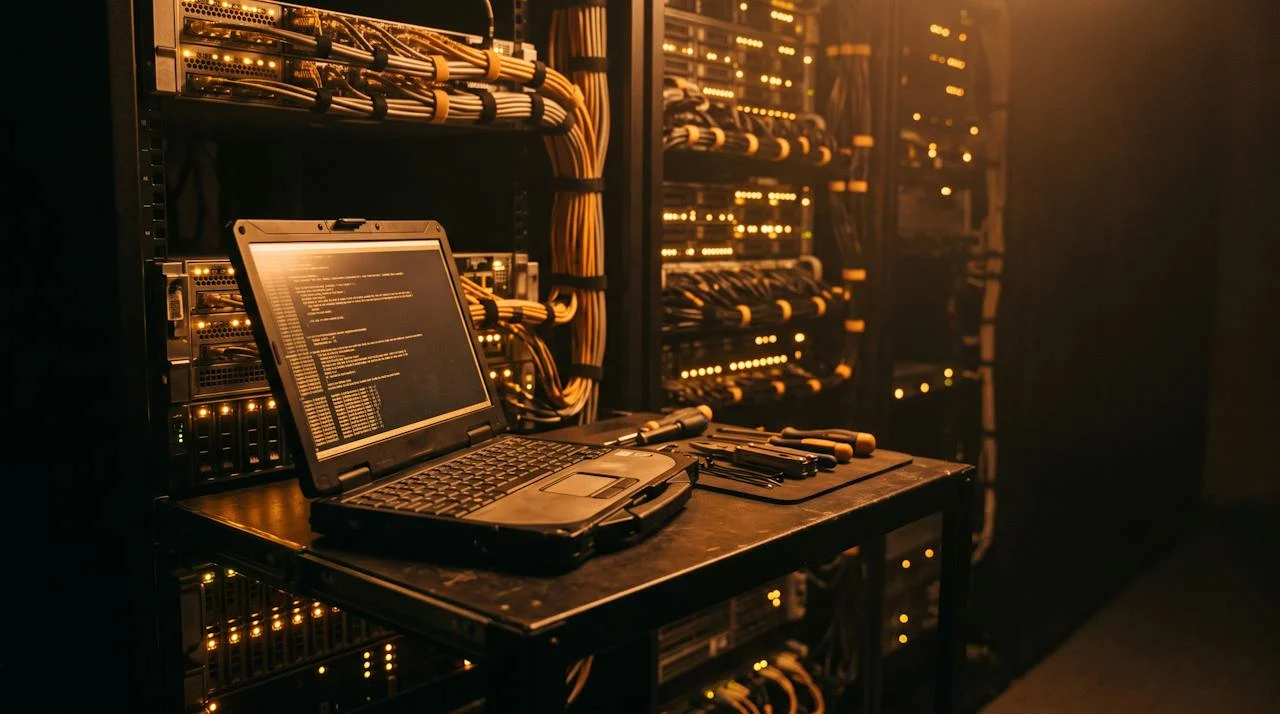
That fan moves air around. It does not move heat out. Every watt your equipment draws becomes heat in that room, and unless that heat physically leaves, the temperature keeps climbing until the kit throttles or shuts down.
Heat has to leave the room
Ventilating a small server room is two jobs, not one. You need an exhaust ventilator pulling hot air out, and an intake fan bringing cooler air in. One without the other does very little: an exhaust fan with nowhere to draw replacement air from is fighting a vacuum, and an intake fan with nowhere to push the old air just raises the pressure.
Position matters as much as the fans themselves:
- Exhaust high. Hot air rises, so the extract point belongs near the ceiling, on the opposite side of the room from the intake.
- Intake low. Cool air enters near the floor, where it is coolest, and gets drawn up and across the equipment on its way to the exhaust.
- Diagonally opposed. Intake and exhaust on the same wall will short-circuit, with fresh air going straight back out without ever reaching the rack.
- Align with the racks. Equipment pulls in at the front and blows out at the back. Set the room airflow to work with that, not across it.
Sizing it properly
You size ventilation on the heat you are removing and the temperature rise you will accept. The equipment load in watts is the heat load, and the airflow needed follows from it:
CFM = (watts × 3.412) ÷ (1.08 × temperature rise in °F)
A 2,000 W load, allowing a 15 °F rise over the incoming air: (2000 × 3.412) ÷ (1.08 × 15) = about 420 CFM.
Add margin on top of that figure, because filters clog, ducts bend, and a fan rated at 420 CFM in free air will not deliver 420 CFM through a grille and a run of duct. Sizing for roughly half again gives you room to run the fans slower and quieter most of the time.
Check the load with a meter at the UPS rather than adding up nameplate ratings. Nameplates describe the worst case, and you will usually find the real draw is well under half of it.
Keep the room slightly positive
If the intake is filtered and moves marginally more air than the exhaust, the room sits at a slight positive pressure. Air then leaks outward through gaps around the door and cable entries, instead of drawing dust in through them. In an office server room, where the room next door has carpet and people, that difference shows up on your filters and fan blades within a year.
Can you vent it into the attic?
This comes up on nearly every small server room, because the ceiling is the shortest run and the attic is right there. The answer is no — not as a destination. Duct through the attic if you need to, but terminate outside.
Three reasons it goes wrong:
- The attic is the hottest space in the building. In an Arizona summer it can sit well above 130 °F — hotter than the room you are trying to cool. Your exhaust fan is then pushing heat into air hotter than its source, and a good share of it conducts back down through the ceiling.
- Codes generally require exhaust to discharge outdoors. It is the same rule that stops you venting a bathroom fan or a dryer into an attic, and it applies to mechanical exhaust here too. Worth confirming locally before you cut anything.
- Moisture. In cooler months, warm air meeting cold roof sheathing condenses on it. That is how attics grow mould and sheathing rots — a slow, expensive problem that surfaces long after the fan went in.
The right version costs very little more: insulated duct from the ceiling grille, through the attic, to a dedicated roof cap or gable vent, with a backdraft damper so nothing blows back in and an insect screen on the termination. Keep the run short and as straight as you can, because every elbow costs you airflow you paid for.
For the same reasons, do not take your intake air from the attic either. It is the hottest, dustiest air in the building.
The mistakes that undo it
- Exhausting into a ceiling plenum that feeds the same room’s supply. The heat takes a lap and comes straight back.
- No filter on the intake, so you are pulling dust straight onto the boards you are trying to protect.
- Running the fans continuously instead of on a thermostat. On a cold morning you are pumping cold, damp outside air over the equipment.
- Propping the door open. It vents the heat into the office and makes the room’s own airflow meaningless.
- Boxes stacked in front of the intake. Server rooms accumulate storage; the vents are the first thing buried.
Know before it gets hot
Fit a temperature sensor at the top of the rack, where it is hottest, not on the wall by the door. Set an alert that reaches someone out of hours. The point of ventilation is that nothing happens; a sensor is how you find out it has stopped working before the hardware tells you.
If your room runs warm, the answer is rarely a bigger air conditioner. It is usually somewhere for the heat to go.